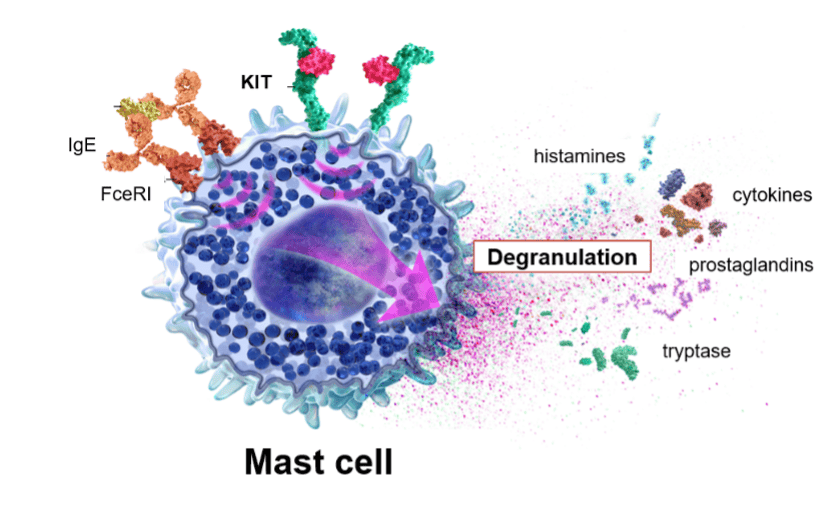
Mast Cell Disorders
Clinic Referral Guidelines and Criteria
Our clinic has experienced an increase in referrals for the evaluation of possible Mast Cell Activation Syndrome (MCAS). Given the high demand for mast cell disease referrals and our limited number of clinic slots, we regret that we are unable to accept all new patients at this time.
Referral Requirements
To help us serve patients more efficiently and ensure appropriate use of specialty resources, we kindly ask that referring providers include the following with each referral:
1) Recent visit note which includes current symptoms concerning for MCAS and medications which are currently being used or have been tried in the past for management of symptoms
2) Lab data as below
- Baseline Serum Tryptase
- Acute Serum Tryptase (obtained within 1 hour of symptom onset during acute attack)
- Additional testing if completed
- 24-hour urine N-methyl histamine
- 24-hour urine prostaglandin D2 or 11β-PGF2α
- 24-hour urine Leukotriene E4
- KIT D816V testing
- Bone marrow biopsy
- Skin biopsy (for cutaneous mast cell disease)
All cases will be reviewed by our physicians. Only patients meeting clinical criteria for mast cell disease as defined will be accepted for evaluation.
Understanding Mast Cell Disorders
Mast cells are crucial components of the innate immune system, residing primarily in mucosal and connective tissues near blood vessels and nerve endings. When activated, they release inflammatory mediators—such as histamine, tryptase, prostaglandins, and leukotrienes—into the surrounding tissues.
While essential for defending against pathogens and mediating allergic reactions, abnormal or excessive mast cell activation leads to chronic, multisystem symptoms. Below is an overview of key mast cell-related conditions designed for patient education.
1. Mastocytosis
Mastocytosis is a rare clonal disorder characterized by an abnormal accumulation and proliferation of mast cells in one or more organ systems (skin, bone marrow, gastrointestinal tract, liver, spleen, and lymph nodes).
-
Cutaneous Mastocytosis (CM): Primarily affects the skin, most commonly presenting in pediatric patients as urticaria pigmentosa (red-brown macules or papules that cause localized hives when stroked, known as Darier’s sign). It frequently resolves or improves significantly by puberty.
-
Systemic Mastocytosis (SM): Characterized by the infiltration of mast cells into extracutaneous organs, predominantly the bone marrow. It is typically driven by somatic activating mutations in the KIT gene (most commonly D816V). SM is further subclassified into indolent, smoldering, aggressive, and variants associated with hematologic neoplasms.
2. Mast Cell Activation Syndrome (MCAS)
MCAS is a distinct clinical entity where patients experience chronic, recurrent episodes of mast cell mediator-release symptoms affecting multiple organ systems, but without the clonal proliferation or tissue infiltration seen in mastocytosis.
-
Primary MCAS: Driven by intrinsic genetic mutations or clonal mast cell populations that do not meet the diagnostic thresholds for systemic mastocytosis.
-
Secondary MCAS: Occurs when mast cells are chronically activated by an underlying IgE-dependent allergy, chronic infection, physical stimuli, or autoimmune processes.
-
Idiopathic MCAS: Symptoms and diagnostic criteria are fully met, but no underlying trigger or clonal driver can be identified.
Diagnostic Criteria & Specific Testing
Accurate diagnosis requires a combination of clinical evaluation, laboratory biomarkers, and exclusion of mimickers.
Diagnostic Criteria for Mast Cell Activation Syndrome (MCAS)
Per consensus guidelines, a definitive diagnosis of MCAS requires meeting all three of the following criteria:
-
Clinical Symptoms: Episodic, recurrent, multisystem symptoms involving at least two organ systems (e.g., dermatological, cardiovascular, gastrointestinal, respiratory, or neurological).
-
Biomarker Elevation: Documented significant increase in validated mast cell mediators during a symptomatic flare compared to a baseline, non-symptomatic state.
-
Treatment Response: Substantial improvement or resolution of symptoms following the administration of mast cell-stabilizing agents, mediator receptor blockers, or avoidance of triggers.
Specific Diagnostic Tests
-
Serum Total Tryptase: The primary baseline screening biomarker. Consistently elevated baseline levels (>20 ng/mL) strongly suggest systemic mastocytosis. More moderate elevations may be seen with hereditary alpha-tryptasemia (HaT). Following international consensus guidelines for the diagnosis of MCAS (Valent et al.), an acute rise in serum tryptase during a reaction compared to the patient’s baseline serves as the most specific biochemical marker. This elevation should amount to at least 20% of the baseline plus 2 ng/ml, and is typically obtained within 4 hours of a reaction.
-
24-Hour Urinary Mediators: Measurement of urinary metabolites during a symptomatic flare, including:
-
N-methylhistamine
-
2-dinor-11β-prostaglandin F2α
-
Leukotriene E4
-
-
Bone Marrow Biopsy & Aspirate: Indicated when systemic mastocytosis is suspected due to persistently elevated baseline tryptase or unprovoked anaphylaxis. Evaluation includes bone marrow histology, immunohistochemistry for CD117 and CD25 expression, and KIT D816V mutation analysis via allele-specific PCR.
-
Skin Biopsy: Performed for suspected cutaneous mastocytosis to assess for mast cell aggregates in the dermis.